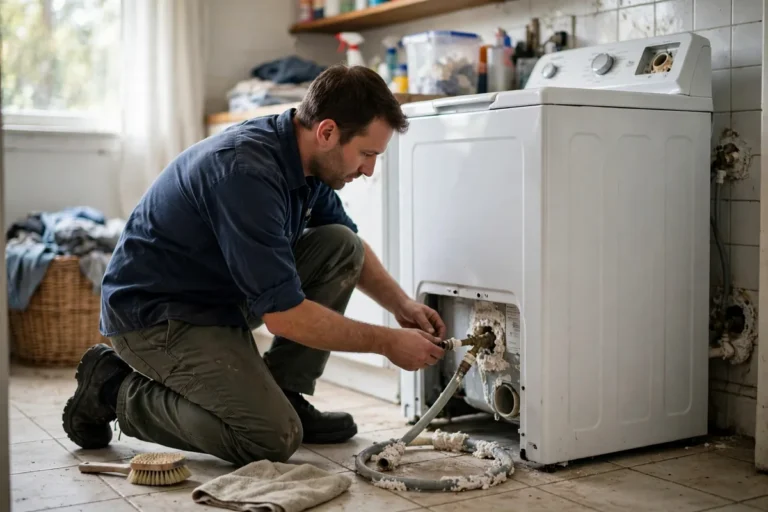
That Musty Smell? You Are Not Alone
Open the washer door and get hit with that damp, sour punch — if that sounds familiar, you are in good company. One of the most common questions we hear from Abilene homeowners is some version of “why does my washing machine smell,” and the answer is almost never “because it is broken.” A smelly washing machine is usually a dirty washing machine. Somewhere out of sight — in the door seal, behind the drum, in the drain filter — a film of detergent, fabric softener, lint, body oils, and minerals has been building up load after load, and bacteria and mold have moved in.
Front-loaders get the worst of it. A front load washer smells more often than a top-loader because its door has to seal watertight while it runs. That thick rubber bellows around the opening has folds that hold a little water after every cycle. Add warm lint, leftover soap, and a door that stays shut between wash days, and you have the ideal recipe for washing machine mold. Top-loaders are not immune — the same film coats the outer tub and the dispenser housing — but the sealed, damp environment of a front-loader is where odors get truly impressive.
Here is the good news. Below is how to clean a smelly washing machine the way we recommend it to our own customers — and why a smelly washing machine Abilene TX homeowners call us about is so often a maintenance problem, not a repair problem. What to clean, in what order, what actually works, where the popular home remedies fall short, and the point where DIY ends and a technician begins.
The 4 Usual Causes of a Smelly Washing Machine
When the smell is musty, sour, or like a damp basement, the culprit is almost always one of four things. In our experience they often team up, which is why a single wipe-down rarely fixes it for long.
1. Mold in the door seal
On a front-loader, the rubber bellows — the door gasket — is ground zero. Its folds trap water, lint, hair, and the odd lost sock after every load. Because the door closes tight, that moisture has nowhere to go, and mildew grows happily in the dark. If you pull the seal back and see black or gray spotting, you have found at least part of your smell. On top-loaders, the equivalent trouble spot is under the lid rim and around the softener dispenser cup.
2. Detergent and fabric softener buildup
More soap does not mean cleaner clothes — it means more residue. Excess detergent and liquid softener never fully rinse away, especially in cold water. They coat the inner drum, the outer tub you cannot see, and the dispenser drawer, forming a sticky layer that bacteria feed on. This is the number-one habit behind chronic odor in the homes we visit: a full cap of detergent in every load, softener in every rinse, and cold water doing the rinsing.
3. Drain and filter residue
Water that never fully leaves the machine goes sour. The drain pump filter — the little trap behind the access panel at the bottom front — catches coins, lint, and hair, and the water sitting in and around that debris can turn stagnant. A drain hose with a low sag or a partial clog does the same thing: dirty water lingers, and the smell wicks back into the tub.
4. Hard water plus low-temperature washes
Minerals do not smell by themselves, but they give odor something to hold onto. Limescale roughens every surface inside the machine, and biofilm grips that rough surface far better than smooth metal or plastic. Wash almost exclusively in cold water and the machine never gets the hot flush that keeps that film in check. In a hard-water city, this combination quietly makes everything else worse.
How to Clean Washing Machine Seal Mold, Step by Step
Start here, because the seal is the single biggest odor source in most front-loaders, and learning how to clean washing machine seal mold properly is the step most quick guides rush past. Put on rubber gloves — you are dealing with mildew, and some cleaners irritate skin.
- Open the door wide and pull the rubber bellows gently back with your fingers. Work your way around the whole opening, including the bottom, where water pools.
- Wipe every fold with a cloth dampened in warm water with a small squirt of mild dish soap — or a diluted bleach solution (about half a cup of household bleach per gallon of water) used entirely on its own. Never mix bleach with other cleaners: bleach plus ammonia or acids can release dangerous gases. If you prefer to skip bleach, an oxygen-based cleaner mixed per its label works too.
- For stubborn black spotting, work the cleaner into the rubber’s texture with an old soft toothbrush. Be patient, and skip abrasive pads — they can nick the bellows, and a torn seal leaks.
- Check the small drain holes at the bottom of the bellows and clear any lint plugging them. Those holes exist so trapped water can escape.
- Dry the seal thoroughly with a clean towel, then leave the door ajar so the rubber dries completely.
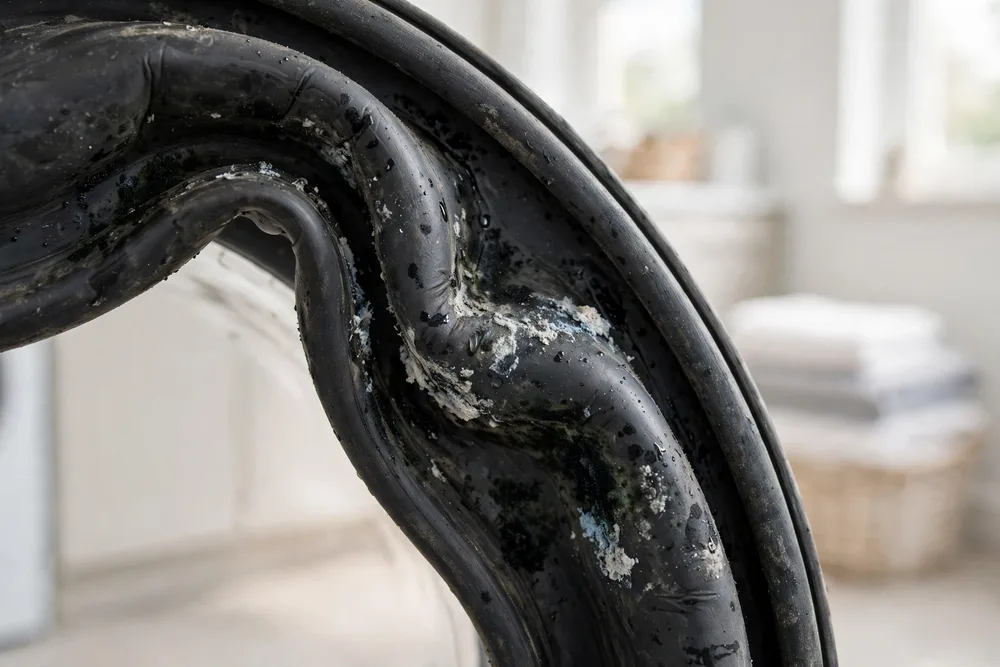
A word of honesty: if the mold has grown into the rubber itself — dark staining that will not budge, or a seal that stays slimy no matter how carefully you clean it — no amount of scrubbing restores it. At that point the bellows needs replacing, which is a technician job. The seal is clamped to the tub and the front panel with a spring-and-wire retainer, and seating it wrong means leaks.
Drum and Dispenser Deep Clean: The Hot Cycle That Actually Works
With the seal handled, turn to the drum, the outer tub, and the dispenser drawer — the places a cleaning cycle can reach that your hands cannot.
- Pull out the detergent drawer. Most release with a small tab or button. Soak it in hot water, scrub every compartment and the drawer cavity with a brush, and rinse clean. The softener compartment is usually the worst offender.
- Run the machine’s hottest, longest cycle — “Tub Clean,” “Clean Washer,” or a heavy-duty hot wash — with a formulated washer cleaner (tablet or powder), following the product’s directions. These products use oxygen-based cleaners and surfactants designed to break down detergent residue and biofilm, which is exactly what is causing the smell.
- Wipe the drum and the inside of the door glass after the cycle, and leave the door open for a few hours so everything dries fully.
A note on vinegar, because it comes up on nearly every service call: distilled white vinegar can dissolve light mineral film and knock an odor back for a day or two, and a cup in an empty hot cycle is not going to destroy your machine. But vinegar does not dissolve detergent residue and biofilm the way a formulated cleaner does, and repeated vinegar soaks can dry out and degrade rubber seals and hoses over time. Think of vinegar as a mild mineral rinse, not a deep cleaner — it helps a little, it does not fix the problem.
Two safety rules that matter here. Never mix bleach with other cleaning products, and never pour chemicals into the machine at random — use one product at a time, measured per its label, with the machine empty. Cleaning chemistry is not a place to improvise.
The Filter and Drain Check (The Short Version)
If your washer has a drain pump filter — most front-loaders and some top-loaders do, behind a small panel at the bottom front — it is worth a look. Lint, hair, and a surprising number of coins collect there, and the water trapped around that debris is a classic sour-smell source. Put towels and a shallow pan under the panel, unscrew the filter, rinse it clean, screw it back in firmly, and run a short drain-and-spin to confirm nothing drips.
That is the short version. Our washing machine maintenance guide walks through the full filter cleaning step by step, and if you are also seeing standing water or slow draining, our washer not draining guide covers what that means. Five minutes on the filter solves more odor complaints than most people expect.
Prevention Habits That Keep the Smell Gone
Killing the odor once is satisfying; keeping it gone is the real win. These are the habits we recommend after every odor call, because a front load washer smells again fast when the routine slips:
- Leave the door or lid ajar between wash days. Airflow is the cheapest deodorizer there is. If small children or pets are a concern, a door prop that leaves a one-inch gap still helps enormously.
- Dose detergent correctly. Use HE detergent in an HE machine and measure it — for a normal load, the lowest line on the cap is usually plenty. More soap does not clean better; it just feeds the film.
- Run a hot cleaning cycle monthly with a proper washer cleaner — not just when the smell comes back. Prevention beats rescue.
- Wipe the seal and leave the dispenser drawer cracked after laundry day. Thirty seconds while you move clothes to the dryer.
None of this is exotic, which is exactly the point. Odor is a buildup problem, and buildup is a routine problem.
Why Abilene Washers Smell Faster
A quick local note, because Abilene stacks the deck. Our water is very hard, and as we cover in our hard water washing machine guide, mineral scale gives biofilm a rough surface to grip — so odor builds faster here than in soft-water towns. Add West Texas humidity and older laundry rooms, where washers sit in tight utility closets with little airflow, and a front-loader here can go from fresh to funky in weeks rather than months. The short version: in Abilene, the monthly hot cleaning cycle is not optional. It is the routine that keeps everything else working.
When the Smell Means It Is Time to Call a Pro
Most washer odor is DIY territory. Call us when it is not:
- The smell survives a full, careful clean — seal scrubbed, hot cycle with a real cleaner run, filter cleared. Lingering odor after all that usually means buildup where you cannot reach: the outer tub, the drain pump housing, or an internal hose.
- There is a leak along with the smell. Water escaping where it should not be is never a cleaning issue. Our washer leaking water guide covers what to check first — then call.
- Error codes keep appearing. Drain codes especially, since a struggling pump and a smelly filter are often the same problem. Our common washer error codes guide translates what the display is telling you.
That is exactly what our $79 diagnostic is for. We test the machine in order, find the real cause, and give you one written price before any work begins. The $79 is credited in full toward the repair, and every completed repair leaves with a written warranty. We are open Monday through Saturday, 8 AM to 6 PM — call (325) 555-1234.
If the machine is older and the smell is just one symptom among several, our repair or replace guide walks through the math, and our repair cost guide shows typical prices for common fixes in Abilene, so you can sanity-check any quote — including ours. For an overview of everything we fix, start at our washing machine repair hub. And if you are weighing a new machine instead, ENERGY STAR’s page on washing machines is a solid reference for what efficient models actually save.
Smelly Washing Machine Abilene TX: Frequently Asked Questions
Why does my washing machine smell like mildew — or like rotten eggs?
A mildew smell is almost always biofilm: bacteria and mold growing on detergent residue in the seal, dispenser, outer tub, or filter. A rotten-egg (sulfur) smell is different — it can come from bacteria in the water supply or the drain itself rather than the washer. Quick test: run the hot tap at a nearby sink. If the sulfur smell is there too, the issue is likely your water or plumbing, not the machine.
How do I clean a smelly washing machine fast?
The fastest effective pass: wipe the door-seal folds thoroughly, pull and scrub the dispenser drawer, then run the hottest cycle with a formulated washer cleaner. That hits the three biggest odor sources in about an hour of mostly unattended time. Skip the all-day vinegar soaks — they do not clean as deeply, and they waste a day.
Why does my front load washer smell worse than my old top loader did?
The watertight door seal. A top-loader’s lid does not seal, so the tub airs out between loads. A front-loader’s rubber bellows seals tight and holds water in its folds, creating a dark, damp home for mildew. The fix is not to go back to a top-loader — it is the routine above: door ajar, correct dosing, monthly hot clean.
Is washing machine mold dangerous?
For most people it is a nuisance — an unpleasant smell that transfers to laundry — rather than a health emergency. That said, mold and the bacteria in biofilm can aggravate allergies or asthma in sensitive people, so it is worth cleaning promptly rather than living with it. Wear gloves when you scrub the seal, ventilate the room, and if anyone in the home has a serious respiratory condition, have someone else do the cleaning or call us to handle it.
How often should I clean my washing machine to keep odor away?
Run a hot cleaning cycle with a proper cleaner once a month, wipe the door seal after laundry day (or at least weekly), and clean the drain pump filter every two to three months — monthly if you have pets. In Abilene’s hard water, do not stretch the monthly cycle; scale helps odor return faster here.
Can I use vinegar and baking soda to clean my washing machine?
You can, but know what you are getting. Vinegar helps with light mineral film and can freshen odor temporarily; baking soda is a mild deodorizer. Neither dissolves the detergent residue and biofilm behind most washer odor the way a formulated washer cleaner does, and repeated vinegar soaks can degrade rubber seals over time. Use them as a light freshen-up if you like — not as your deep-clean plan.
Still Smelly After the Full Clean? Let WasherFixPros Take a Look
If you have worked through this guide and the odor is still there — or if the smell came with a leak, a noise, or an error code — that is what we are here for. WasherFixPros is Abilene’s washer-only repair team: one $79 diagnostic visit, credited in full toward your repair, one written price before any work begins, and a written warranty on every completed repair. We are open Monday through Saturday, 8 AM to 6 PM, and active-duty military and veterans save 10% on labor. Learn more about us, or reach out through our contact us page — or just call (325) 249-7174.