
If your washer keeps breaking down and you live in Abilene, the problem might not be the brand on the front or the number of years on the clock — it might be the water going in. Abilene’s supply is very hard water, and hard water washing machine Abilene damage is one of the most common, and most overlooked, reasons washers wear out early across our city.
The short answer: yes, hard water shortens a washing machine’s life. Dissolved calcium and magnesium form limescale on inlet valves, hoses, pumps, and heating elements, and over time that buildup causes slow fills, leaks, error codes, and parts that fail years before they should. The good news: a few simple habits slow the damage dramatically — and when parts do give out, most of the hard-water repairs we do fall in the same $120–$350 range as our other common jobs, with the $79 diagnostic credited in full toward the repair.
This guide explains what “very hard” actually means, how mineral buildup attacks each part of your washer, the seven warning signs to watch for, what you can safely do yourself, and when it is time to call a technician. And if your machine is getting older and you are weighing the bigger question, our guide to whether it is worth repairing a washing machine walks through the age-and-cost math we use on every service call.
Hard Water Washing Machine Abilene: What “Very Hard” Really Means
Water hardness is simply the amount of dissolved calcium and magnesium in the water, as the U.S. Geological Survey explains. The USGS classifies anything over 180 mg/L as “very hard” — and Abilene sits well past that line.
The City of Abilene publishes an annual water quality report, and its testing puts local hardness around 240 mg/L — roughly 14 grains per gallon. That is the city’s own reported figure, not our measurement, and it can vary by water source and season since the city blends supplies. But the takeaway is steady: by the national scale, Abilene’s water is firmly in “very hard” territory. You can read the city’s latest annual water quality report if you want the full tables.
What does that mean in plain terms? The same minerals that leave spots on your dishes and crust on your faucets are flowing into your washer with every load. Heat makes it worse: every hot-water cycle bakes a fresh layer of scale onto valves, hoses, and heating elements. A little buildup is harmless. Years of it is what sends washers to an early grave — which is why a hard water washing machine Abilene families depend on often needs parts sooner than the same model would in a soft-water town.
The short version: Abilene’s water is very hard — about 240 mg/L per the city’s own testing. Hard water won’t hurt you, but it is rough on washers. A simple maintenance rhythm keeps it from turning into repair bills.
How Hard Water Damages a Washing Machine, Part by Part
The effects of hard water on washing machine parts are gradual and cumulative. Here is where we see the damage, in the order the water meets it. That’s the pattern of hard water washing machine Abilene damage we see most: it starts at the inlet and works its way through the machine.
Inlet valves and screens
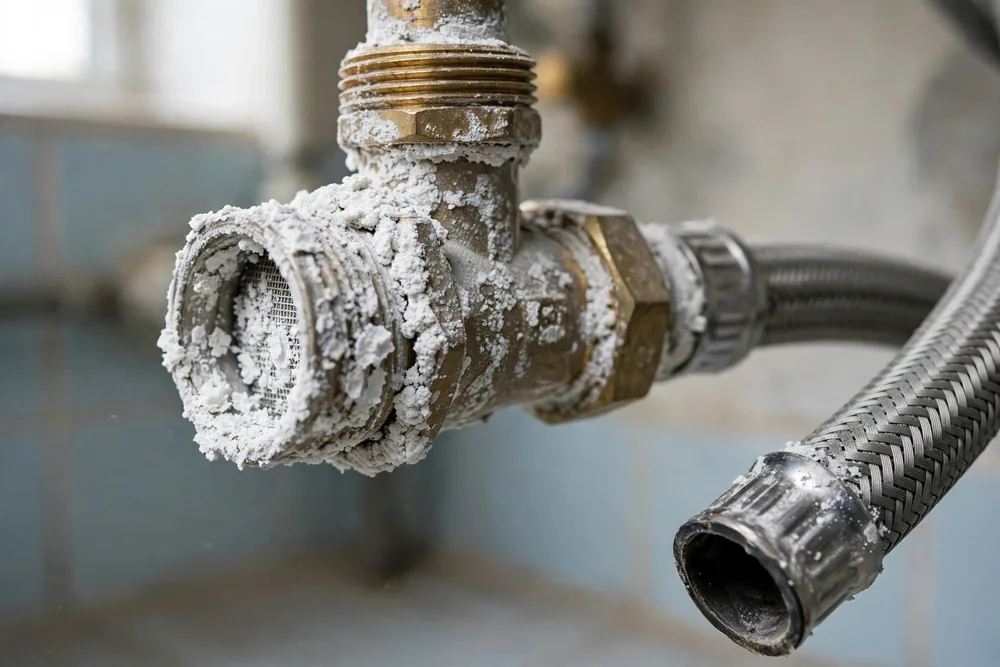
Water enters your washer through the inlet valve, which has fine mesh screens to catch sediment. In hard-water homes, those screens crust over with mineral deposits first. Flow slows to a trickle, the washer takes forever to fill — or the valve sticks and won’t open fully at all. A scaled-up hard water inlet valve is one of the most common parts we replace in Abilene, and it is also one of the more affordable fixes. If your washer is struggling to fill, our washer won’t fill guide walks through the inlet filter and valve checks in detail.
Inlet hoses
Rubber inlet hoses crust up inside and, more importantly, at the couplings where they meet the valve and the wall tap. Mineral deposits chew at washers and seating surfaces, which is how pinhole seeps and drips start at the back of the machine — the kind you don’t notice until the baseboard swells. We cover the warning signs on our washer leaking page.
Drain pump
Scale and grit don’t just ride in — they ride out, too, straight through the drain pump. Over time the abrasive mix wears the pump and strains the motor, which is why a pump in a hard-water home can get loud or weak years early. If yours is humming harder than it used to or leaving water behind, see our washer not draining guide.
Heating element
Limescale is an insulator. As it coats the heating element, the washer has to run longer to reach temperature — longer cycles, higher electric bills, and an element working overtime until it burns out. This is the hidden cost of hard water: you pay for it in energy long before you pay for it in parts.
Drum, seals, and dispenser
Inside the tub, scale mixes with soap residue into a stubborn film on the drum, the door seal, and the detergent dispenser. Dispensers clog so detergent never fully flushes; door seals trap moisture and grow the musty smell that survives cleaning cycles. Limescale buildup in washing machine drums also gives odor-causing residue more surface to cling to, which is why the smell keeps coming back.
Hard Water Washing Machine Abilene: 7 Warning Signs
You don’t need a lab test to suspect hard water. If several of these sound familiar, mineral buildup is a strong suspect — and a hard water washing machine Abilene checkup can confirm it before a small problem becomes a failed part:
- White spots on dark clothes; towels feel stiff and scratchy. Minerals don’t rinse out clean. If dark loads come out with white residue and towels feel like sandpaper, your water is leaving its signature on everything.
- Slow fill, or a fill that stops halfway. The classic clogged-screen symptom. If the washer used to fill in minutes and now takes its time — or gives up — the inlet path is narrowing.
- IE or 4C fill error codes. LG’s IE and Samsung’s 4C both mean the washer isn’t getting water fast enough. Before you assume a bad valve, check our washer error codes guide — the fix is sometimes just a cleaning.
- Small leaks at hose connections or valves. Crusty white or greenish deposits around couplings, or a damp spot behind the washer that comes and goes, point to mineral-worn seals. More on what to check on our leaking washer page.
- Cycles run longer than they used to. A scaled heating element takes longer to heat water, so the machine stretches the cycle to compensate.
- A musty smell that survives cleaning cycles. If you’ve run cleaner through it and the smell returns within weeks, scale inside the drum, seal, or dispenser is likely sheltering the residue.
- The drain pump sounds strained. Grinding, humming, or sluggish draining means the pump is fighting buildup. Our not draining guide covers the filter check you can do yourself.
What You Can Do Yourself
You can’t change your water supply, but you can absolutely slow the damage. A simple hard water washing machine Abilene maintenance rhythm takes less than an hour a year: Start with the two highest-impact habits: a regular empty hot descale cycle and keeping the inlet screens clear. Those two alone head off most of the effects of hard water on washing machine parts that we see on Abilene repair calls.
- Run an empty hot descale cycle. Every month or two, run the washer empty on the hottest setting with a washing machine cleaner, following the product’s directions. This is the single best routine answer to how to descale a washing machine — it dissolves fresh scale before it hardens into the kind that needs tools.
- Clean the inlet screens and the pump filter. Washer filter cleaning is a twice-a-year job in hard-water homes: pull the inlet hose screens and rinse off the crust, and clear the drain pump filter behind the little access panel (on front-loaders) as your manual shows. If flow improves afterward, you’ve just confirmed the diagnosis.
- Check hoses for crust and cracks. Once a year, pull the washer out and look at both inlet hoses. White crust at the couplings, bulges, or any cracking means replace them — hoses are cheap, water damage is not.
- Dose detergent for hard water. Hard water needs the full recommended detergent dose to clean well — skimping leaves residue on clothes and in the machine. But don’t overdo it either; excess suds plus minerals make the film problem worse.
Safety first: always unplug the washer before you touch anything inside it — hoses, screens, filters, all of it. And never bypass a lid switch or fuse to “test” something. Those parts are there to keep you safe.
What Needs a Technician
Some hard-water damage is beyond DIY. Call us when:
- The inlet valve or drain pump needs replacing. Once a valve sticks or a pump weakens, cleaning won’t bring it back. The good news is that hard water washing machine Abilene repairs are usually straightforward part swaps, and most land in the $120–$350 range.
- There’s scale you can’t reach. Buildup inside the valve body, deep in hoses, or behind the drum needs a technician’s tools.
- Codes keep returning after cleaning. If IE, 4C, or other fill codes come back after you’ve cleaned the screens, the valve itself is likely failing. Our error codes guide explains what each code is telling you.
- Leaks at internal joints. Drips from inside the cabinet — not the hose connections — need a pro. See the leaking guide for how to tell the difference.
- Anything electrical, motor, or drum. Heating elements, motors, wiring, and drum work are never DIY.
That’s exactly what our $79 diagnostic is for: we test the fill, drain, and key parts in order, find the real cause, and give you one written price before any work begins — credited in full toward the repair. Every repair comes with a written warranty. If your washer won’t fill, Abilene TX hard water is one of the first things we check on arrival.
And if the machine is older and the repair is a major one, we’ll tell you straight whether the money is better spent on a fix or a replacement — the same repair-or-replace thinking we walk through in our homeowner’s guide. Learn more about our team — we’re a local, washer-only shop, and washing machine repair across Abilene is all we do, Monday through Saturday, 8 AM to 6 PM, with same-day washer repair appointments in most cases.
How to Protect Your Washer in Abilene’s Hard Water
Think of this as the long game — small habits that add years to a washer in a very-hard-water city. Consistency is what protects a hard water washing machine Abilene owners rely on every day:
- Filter and screen rhythm. In Abilene’s water, check inlet screens and the pump filter every 3–4 months. It takes ten minutes and catches buildup while it’s still soft.
- Descale rhythm. An empty hot cleaning cycle every 1–3 months, depending on how much laundry you do. Households running daily loads should stay on the shorter end.
- Hose replacement habit. Replace rubber inlet hoses every 3–5 years as preventive maintenance — sooner if you see crust, bulging, or cracking. A burst hose can do thousands in water damage; the hoses cost a fraction of that.
- The softener conversation. If you’re tired of fighting scale in every appliance, it’s worth talking to a plumber about a whole-home softener. We’re washer techs, not plumbers, so we’ll leave the advice to them — but we can tell you that softened water is noticeably easier on inlet valves and pumps.
Frequently Asked Questions
Why do my appliances keep breaking in Abilene? Is it the hard water?
Often, yes — at least partly. At about 240 mg/L per the city’s own water quality testing, Abilene water hardness is well into the “very hard” range, and mineral scale is rough on any appliance that heats water or meters it through small valves: washers, dishwashers, water heaters. It doesn’t mean every breakdown is the water’s fault — which is why hard water washing machine Abilene wear is always on our diagnostic checklist. If your washer is on its second or third repair in a couple of years, hard water is a likely contributor.
How do I descale my washing machine?
Run the washer empty on its hottest cycle with a washing machine cleaner, following the product’s directions, every 1–3 months. For the full routine — screens, pump filter, hoses — see “What You Can Do Yourself” above. Deep internal scale, or scale that returns right after cleaning, needs a technician.
Can hard water stop a washer from filling?
Absolutely — it’s one of the most common hard-water failures we see. Mineral deposits clog the inlet screens and scale up the inlet valve until water can’t get through fast enough, which also triggers IE or 4C fill codes. Start with cleaning the screens; if the problem returns, the valve likely needs replacing.
Does hard water cause washer leaks?
It contributes to them. Scale crusts around hose couplings and valve seats, wearing the sealing surfaces until they weep — usually as small, intermittent drips behind the machine. If you see white or greenish crust at a connection, that’s the tell.
How often should I clean the filter in a hard-water home?
Every 3–4 months for the inlet screens and the drain pump filter — about twice as often as the generic guidance in most manuals. In Abilene’s water, waiting a full year lets soft buildup harden into the kind that needs tools. Set a phone reminder the way you would for an HVAC filter — it is easy to forget and expensive to skip. A starved inlet valve works harder on every fill, and a clogged pump filter makes every drain cycle strain.
Is a water softener worth it for my washer?
Softer water means less scale on valves, pumps, and heating elements, so yes, it should extend washer life and cut maintenance. But it’s a plumbing decision with whole-house implications, so talk to a licensed plumber about your home’s setup. We don’t sell or install softeners — we just fix what hard water does to washers.
Not Sure If It’s the Water? Let Us Look First
If several of those warning signs sound familiar, don’t guess — a $79 diagnostic gives you a certain answer. Diagnosing hard water washing machine Abilene damage is a weekly job for us: we’ll test your washer’s fill, drain, and key parts, show you exactly what the water has done, and hand you one written price before any work begins.
The $79 is credited in full toward the repair, every repair carries a written warranty, and military members and veterans get 10% off labor. Call (325) 249-7174 — Monday through Saturday, 8 AM to 6 PM — or book online, or contact us anytime at contact@washerrepairabilene.com. You’ll find us at 500 Chestnut St, Abilene, TX 79602.
4 Comments
Comments are closed.